


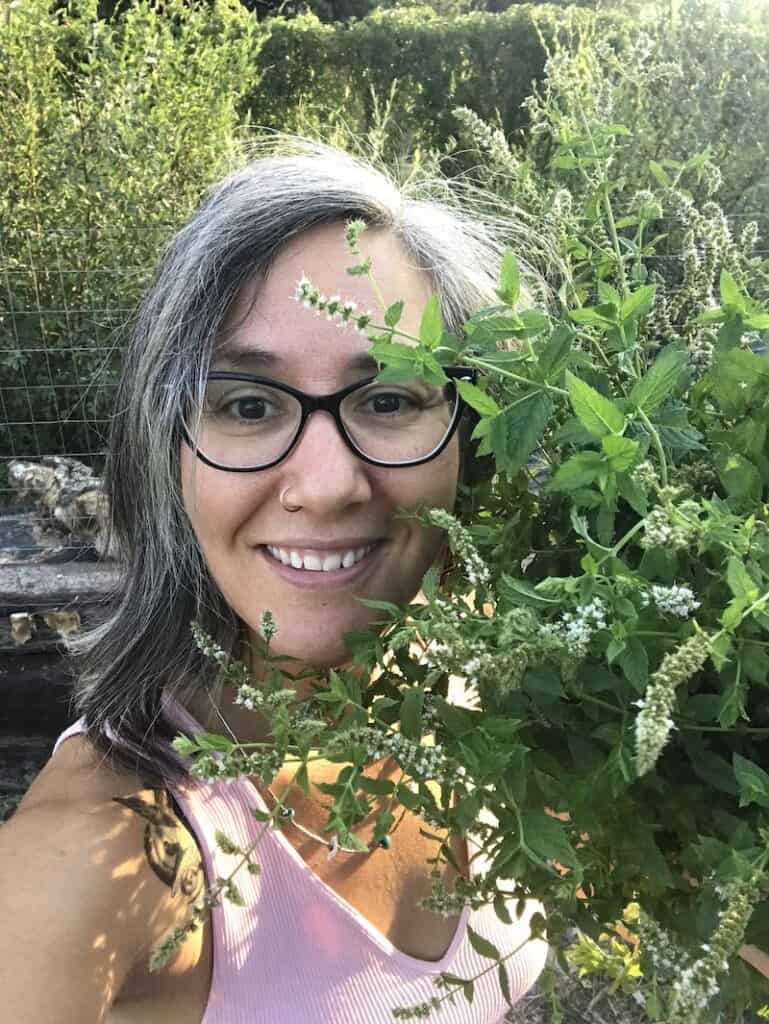
Among the rolling high desert foothills of the Sangre de Cristo Mountains in Northern New Mexico lies a swath of land that has been in this entrepreneur’s family for generations.
Chimayó resident Pilar Trujillo lives in the home her great-grandfather’s family built on what was once 3/4 of an acre. Slowly, through the years, her parents bought back adjacent pieces of land, acquiring a total of 17 acres, a process that took the better part of their lives.
Trujillo has about five acres that she has tended for about 20 years, growing food and medicinal plants that she converts into balms and salves, remedios, or medicines, and sells through her microenterprise, Viva Vida, LLC, or “Live Life” in Spanish.
“Everything I do is just to keep me here,” said the 13th-generation Chimayosa, “keep me here on the land.”
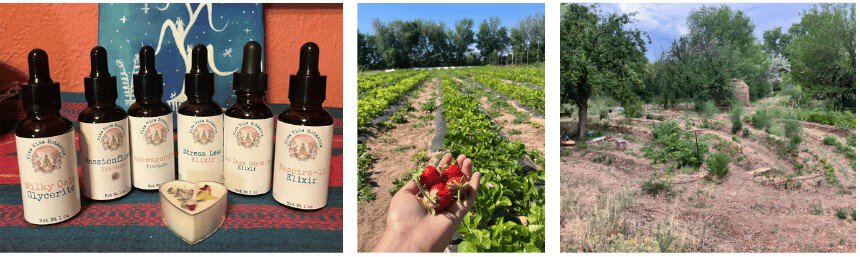
Trujillo’s Viva Vida Botánica products, farm and permaculture
Generations of Hispanic-Indigenous families settled in this historically rich agricultural valley, which was watered by irrigation ditches, or acequias, created by area communities. After the end of the Mexican-American War and the signing of the Treaty of Guadalupe Hidalgo in 1848, the United States sought to ratify land grants and communal property, but much of the land was lost in the process.
In modern times, many in Chimayó have tried to hold on to their parcels but have faced gentrification, high property taxes, or, in some cases, a lack of clear land titles. Now the land is being threatened by out-of-state buyers who want a home on the High Road to Taos. A half-acre lot was listed for $65,000 in Chimayó on a real estate site in September. A large property near Trujillo sold earlier this year for about $750,000 in about 24 hours.
Trujillo, who has transitioned into permaculture, has spent years learning traditional plant medicine practices, studying with community herbalists as far away as Taos and learning from the land itself. Mint, lavender, and rosemary become salves. Elderberry becomes a syrup. Blue corn becomes a body scrub.
“I grew up as a part of it. There was always a salve on the shelf or chamomile tea. In my 20s, I wanted to know more about what was growing around me, and I started asking people in the community,” said Trujillo, who also forages. She noted that this year was one of the toughest growing seasons because of the severe drought and the acequias closing in May. Trujillo also works with local nonprofits, farmers, and youth groups, sharing knowledge and looking for ways to preserve water.
“I’ve been very, very impressed with how supportive The Loan Fund has been,” she said. “They have really been so supportive and I’m so glad they believed in my vision.”
She found The Loan Fund when looking for funding to fix up a rental unit on her property, which makes up part of her income. She heard about community lenders through another organization and, after an internet search using the words “community lender,” Trujillo found what she was looking for. The Loan Fund was able to provide financing through her LLC, allowing her to support ongoing business operations while maintaining the property’s infrastructure.
“The process was super simple. It was all online,” said Trujillo, adding that she was glad The Loan Fund saw her vision of helping her stay on her ancestral land.
“I’m not just trying to be a landlord. I just want to do whatever it takes to keep me connected to the community. So many people have to leave; so many people have to get jobs that they don’t want. Me and so many members of my family want to stay here and not have to live at poverty level. We are showing that you don’t have to leave and you can make a living taking care of the land, and you don’t have to live below the poverty level to have to do that.
“I’ve been very, very impressed with how supportive The Loan Fund has been,” she said. “They have really been so supportive and I’m so glad they believed in my vision.”